Maintenancecovers
Why Is Water Pooling on My Hot Tub Cover?
Jacuzzi describes tapered cover construction as shedding rain and snow so water does not pool on top and encourage sagging. Hot Spring warns that snow and ice weight can bend a cover and break its seal. Surface pooling is not the same problem as a waterlogged foam core.
- By
- TubWise Editorial Team
- Published
- Last updated
- hot tub cover
- water pooling
- rain on spa cover
- snow on cover
Direct answer
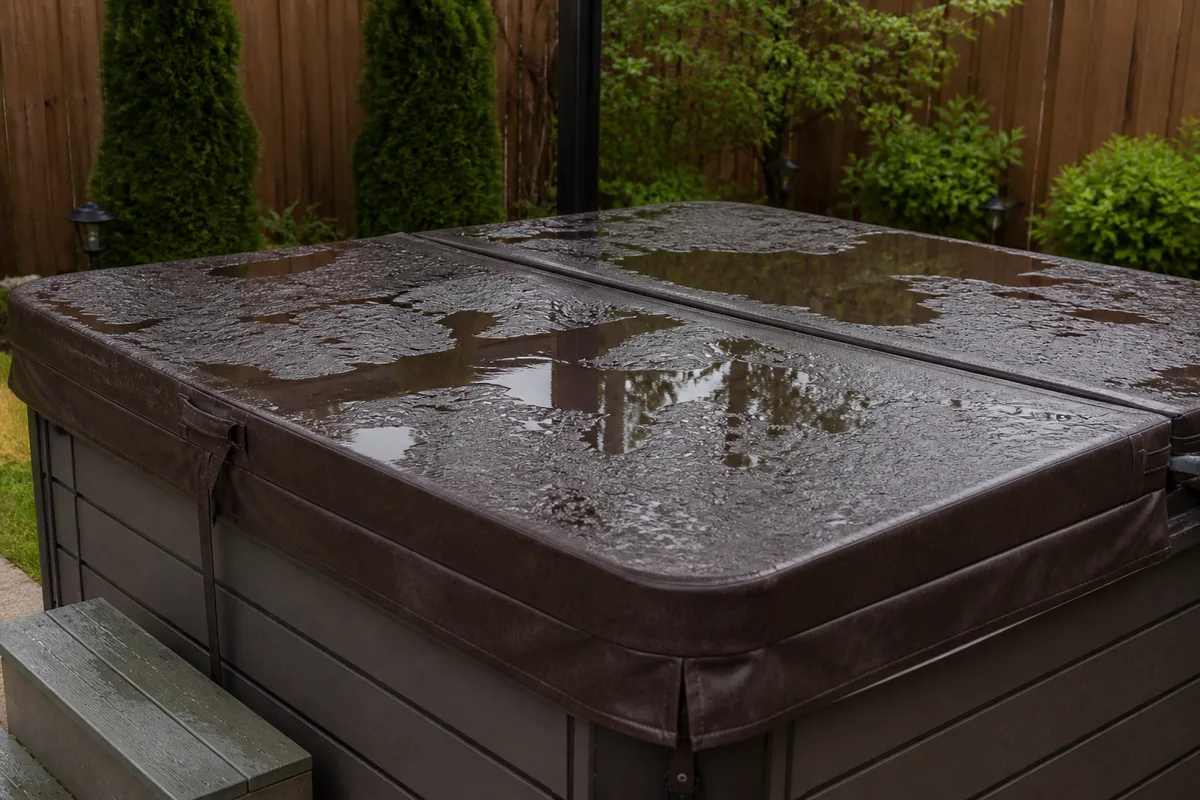
Water pooling on a hot tub cover means rain, meltwater, or melted snow is sitting on the outside of the cover instead of running off. Jacuzzi’s swim-spa cover guidance says tapered construction is meant to shed rain and snow and prevent water from pooling on top, because pooling can lead to sagging and gradual heat loss (Jacuzzi). Hot Spring warns that snow and ice left on the cover can bend it and break the seal (Hot Spring). That exterior water is not the same thing as moisture absorbed inside the foam core.
Safety note
Do not walk, stand, or sit on the cover to push water off, and do not stack heavy objects on it (Hot Spring; Hot Spring Highlife owner’s manual; Jacuzzi). Clear snow with a soft brush as Jacuzzi directs for winter care, not with a sharp shovel that can tear vinyl (Jacuzzi). Loosen ice with warm water before removing it; do not pry or chip it off (Hot Spring). Follow your own cover manual for any snow-load limits, cover caps, straps, and locks.
Surface water vs. water inside the foam
| What you see | What it points to | Next focus |
|---|---|---|
| Puddles on the top vinyl after rain | Exterior runoff is not shedding | Clear water; check taper, hinge dip, debris |
| Snow or ice load on top | Added weight on the exterior | Remove per manufacturer winter steps |
| Cover much heavier after the top is dry and clear | Possible moisture in the foam | See heavy-cover and replacement guides |
Hot Spring describes the foam core as wrapped in a vapor barrier so spa moisture does not soak the insulation from below (Hot Spring). When that barrier fails, weight gain is a different problem from rain sitting on the vinyl. See Why Is My Hot Tub Cover So Heavy?.
Why water sits on top
Lost taper or a dipped center
Jacuzzi states that tapered panels naturally shed rain and snow when the cover shape is intact (Jacuzzi). On the same swim-spa page, Jacuzzi says that in rainy climates you should confirm the taper is shedding water, because pooling accelerates wear and adds weight that stresses hinges and seams (Jacuzzi). A cover that already sags in the middle will hold water where a flat, tapered cover would shed it. See Why Is My Hot Tub Cover Sagging?.
Snow and ice
Hot Spring says not to let snow or ice accumulate on top because the weight can bend and sag the center and break the heat seal (Hot Spring). Jacuzzi’s winter-care page tells owners to remove snow loads exceeding 25 pounds per square foot immediately (Jacuzzi). That limit is Jacuzzi’s stated figure on that page, not a rating for every brand of cover.
Debris or objects that trap water
Leaves, towels, or anything stored on the cover can create dams. Hot Spring and Jacuzzi both tell owners not to use the cover as a table or place for people or objects (Hot Spring; Jacuzzi).
Poor hinge or edge seal
Jacuzzi notes that heat can escape at a poor hinge seal (Jacuzzi). A hinge that does not meet evenly can also leave a low spot where rain collects. That is a fit and condition issue, not proof the spa heater failed.
Safe checks
- Brush or wipe standing water off after storms when it is safe to do so.
- Remove snow promptly with a soft broom or brush (Jacuzzi; Hot Spring).
- Warm-water loosen ice before lifting ice sheets (Hot Spring).
- Look for a permanent center dip after the top is clear.
- Check for tears or punctures in the top skin that could let exterior water into lower layers (Hot Spring).
- Confirm straps and locks still hold the cover flat in wind (follow your manual).
Jacuzzi’s winter-care page also describes cover caps as an extra layer that can help shield a cover from ice buildup, snow, and rain (Jacuzzi). Use only products and accessories your spa or cover maker documents for your model.
What not to do
- Do not drill drain holes through the cover unless your exact manufacturer documents that repair.
- Do not pressure-wash the cover unless your cover maker allows it.
- Do not confuse a wet top with a waterlogged foam core.
- Do not leave chemical vapors trapped under a closed cover right after dosing; Hot Spring advises leaving the cover off about half an hour after treating the water so vapors are not trapped against the cover material (Hot Spring, from its cover-life guidance in the replacement articles).
When to replace or call a dealer
If the cover keeps ponding because it no longer sheds, or if clearing water still leaves a sagging, heavy cover, use the replacement signs in When Should You Replace a Hot Tub Cover?. For measuring a new cover, see How to Choose a Hot Tub Cover. Keep the vinyl clean on a monthly schedule with How to Clean a Hot Tub Cover.
Sources
- Swim Spa Cover Options: Choosing the Right Protection — Jacuzzi; Accessed 2026-08-03
Official Jacuzzi swim-spa page. Tapered construction sheds rain and snow, preventing pooling that can lead to sagging and heat loss. In rainy climates, ensure taper sheds water; pooling accelerates wear and adds weight that stresses hinges and seams. Soft broom for snow; never sit, stand, or place heavy objects on cover.
- Finding the Perfect Replacement Hot Tub Cover — Hot Spring Spas; Accessed 2026-08-03
Official Hot Spring blog. Do not let snow or ice accumulate; weight can bend and sag the center and break the seal. Cover not furniture; vapor barrier construction background.
- When Should I Replace My Spa Cover? — Hot Spring Spas; Accessed 2026-08-03
Official Hot Spring blog. Remove snow; loosen ice with warm water before removing; do not pry or chip. Do not put objects or people on cover.
- Complete Jacuzzi Guide to Protect Your Investment Through Cold Weather — Jacuzzi; Accessed 2026-08-03
Official Jacuzzi winter-care page. Remove snow loads exceeding 25 lb/ft² immediately; soft brush; do not force ice. Cover caps described as extra protection against ice buildup, snow, and rain on that page.
- The Essential Guide to Hot Tub Covers: Benefits, Types, and Maintenance — Jacuzzi; Accessed 2026-08-03
Official Jacuzzi cover guide. Heat can escape at a poor hinge seal; used for seal/fit context when pooling coincides with poor cover lay.
- Highlife Owner's Manual (EN-US) — Watkins Wellness / Hot Spring; Accessed 2026-08-03
Highlife Collection. Do not walk or sit on cover; do not place metal, heat-transferring objects, or plastic tarps on cover. Highlife scope only.
Related articles
Why Is My Hot Tub Cover Sagging?
A sagging hot tub cover can come from snow load, weight left on top, or moisture problems that change the cover's shape and seal.
Read guideWhy Is My Hot Tub Cover So Heavy?
A hot tub cover can feel heavy from rain or snow on top, normal foam size, or moisture inside the foam after the vapor barrier fails.
Read guideWhen Should You Replace a Hot Tub Cover?
Replace a spa cover when manufacturer wear signs appear: damage, sagging, waterlogging, or a musty foam-core odor that cleaning does not fix.
Read guideHow to Clean a Hot Tub Cover
Clean a vinyl spa cover monthly with mild soap or baking soda on the top, water only on the underside, then condition with a manufacturer-approved protectant.
Read guideHow to Choose a Hot Tub Cover
Choose a replacement hot tub cover by spa dimensions, corner radius, construction, handling, and manufacturer safety hardware.
Read guide