Maintenancecovers
Why Is My Hot Tub Cover Sagging?
Hot Spring lists sagging among replacement signs and warns that snow weight or objects on the cover can bend the cover and break the seal. Jacuzzi describes sagging or warping as a cue that the cover may no longer insulate well. Sagging is a shape problem to inspect; it is not, by itself, a lab proof of every possible structural failure.
- By
- TubWise Editorial Team
- Published
- Last updated
- hot tub cover
- sagging cover
- spa cover maintenance
- snow load
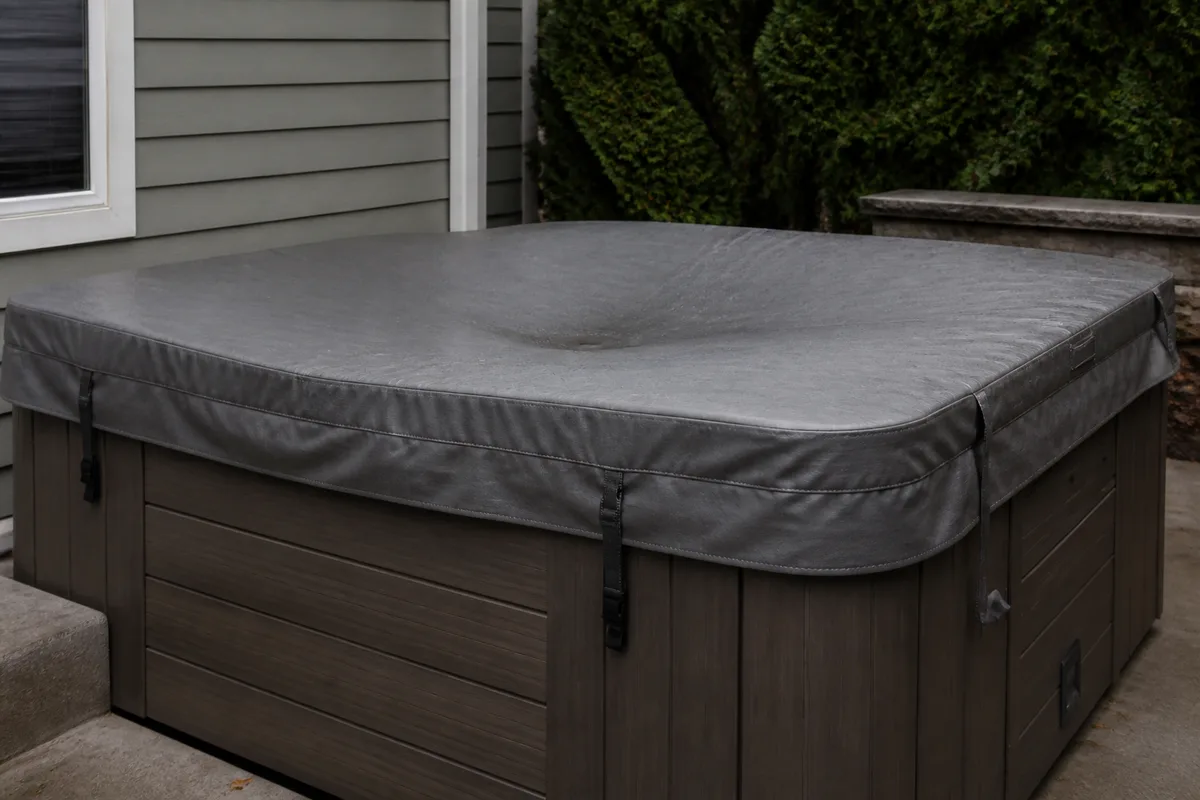
Direct answer
A sagging hot tub cover means the cover no longer lies flat across the spa the way it should. Hot Spring lists sagging among the conditions that call for replacement inspection, because deteriorating shape can let heat and water vapor out and let dust and debris in (Hot Spring). Snow left on the cover, objects or people on top, and moisture-related wear are manufacturer-documented paths that can change cover shape. Sagging alone does not prove every possible internal part has failed.
Safety note
Do not walk, stand, sit, or place heavy objects on the cover (Hot Spring; Hot Spring Highlife owner’s manual; Jacuzzi). Hot Spring also warns against letting children or pets climb on a covered spa (Hot Spring). A cover is not documented here as a platform that can support a person. Follow your spa and cover manuals for straps, locks, snow limits, and lifters.
Why shape matters
Hot Spring’s replacement guide asks whether the cover lies flat or sags in the center (Hot Spring). A center dip can break the seal Hot Spring describes as keeping warm air in and cooler air out (Hot Spring). Jacuzzi states that when a cover sags, it loses the ability to insulate the spa as intended (Jacuzzi). Poor seal can also raise overnight evaporation; if water drops while the spa sits idle, see Hot Tub Losing Water Overnight: Leak or Evaporation?.
Manufacturer-documented causes to separate
Snow and ice on top
Hot Spring says not to let snow or ice accumulate because the weight can bend and sag the cover in the center and break the seal (Hot Spring). Hot Spring also says to remove snow in winter and to loosen ice with warm water before removing it, because prying or chipping can tear the cover (Hot Spring).
Jacuzzi’s winter-care page directs owners to remove snow loads exceeding 25 pounds per square foot immediately, use a soft brush rather than a shovel, and never force ice off (Jacuzzi). That snow-load figure is Jacuzzi’s guidance on that page, not a universal rating for every cover.
Weight left on the cover
Hot Spring titles one care rule “Your hot tub cover is not a table” and warns that objects or people on the cover can stretch and sag it and speed deterioration (Hot Spring). The same Hot Spring replacement article says standing, sitting, or using the cover as furniture can damage the material or cause the foam interior to sag (Hot Spring).
Moisture and water damage
Jacuzzi’s cover-replacement section describes a sagging or warped cover as a sign the cover has sustained water damage and is no longer effective (Jacuzzi). Treat that as Jacuzzi’s framing for that symptom, not as proof that every sag is waterlogging. Pair sagging with weight and seal checks. For heavy foam and vapor-barrier failure language, see Why Is My Hot Tub Cover So Heavy?.
Pooling that no longer sheds
Jacuzzi’s swim-spa cover page says tapered construction is meant to shed rain and snow and prevent water from pooling on top, which can lead to sagging and heat loss (Jacuzzi). Sagging panels that no longer shed rain or snow are listed among wear signs on that page (Jacuzzi). See Why Is Water Pooling on My Hot Tub Cover?.
Safe checks
- Clear snow, ice, and standing water from the top before judging permanent sag.
- Look from the hinge and from each side to see whether the center dips onto the waterline or leaves a gap at the skirt.
- Inspect vinyl, seams, and stitching for cracks, tears, fading, or dry, brittle texture (Hot Spring; Jacuzzi).
- Check straps and locks so wind is not lifting one side while the other hangs (follow your manual).
- Compare weight after the exterior is dry. A cover that is both sagging and much heavier than before fits manufacturer replacement cues more closely (Hot Spring; Jacuzzi).
- Stop using the cover as storage for cushions, coolers, or planters.
What not to do
- Do not force the foam flat with weights, bricks, or by standing on the dip.
- Do not chip ice with metal tools (Hot Spring; Jacuzzi).
- Do not claim the cover can safely hold a child or adult unless your exact cover documentation states a load rating.
- Do not treat sagging as a diagnosis of heater failure.
When to replace or call a dealer
Hot Spring includes sagging in its replace-if list along with breaks, cracks, tears, and fading (Hot Spring). Jacuzzi lists sagging or warping among the main replacement signs (Jacuzzi). If the cover still dips after snow and objects are cleared, or if it no longer seals, move to replacement planning in When Should You Replace a Hot Tub Cover? and fit guidance in How to Choose a Hot Tub Cover.
Sources
- When Should I Replace My Spa Cover? — Hot Spring Spas; Accessed 2026-08-03
Official Hot Spring blog. Replace if breaks, cracks, tears, fading, or sagging; deteriorating condition and shape changes can let heat and vapor out and debris in. Do not put objects or people on the cover; weight can stretch and sag the cover. Remove snow; loosen ice with warm water.
- Finding the Perfect Replacement Hot Tub Cover — Hot Spring Spas; Accessed 2026-08-03
Official Hot Spring blog. Ask whether cover lies flat or sags in the center as a replacement cue. Snow or ice accumulation can bend and sag the center, breaking the seal. Never let children or pets climb on a covered spa; standing, sitting, or using as a table can damage material or cause foam to sag.
- When to Cover Hot Tub: Key Tips for Protecting Your Spa Year-Round — Jacuzzi; Accessed 2026-08-03
Official Jacuzzi guide. Sagging or warped cover listed among replacement signs; Jacuzzi links sagging to water damage and reduced insulation in that article. Attribute Jacuzzi's water-damage framing to Jacuzzi; do not universalize as sole cause of every sag.
- Swim Spa Cover Options: Choosing the Right Protection — Jacuzzi; Accessed 2026-08-03
Official Jacuzzi swim-spa page. Tapered construction sheds rain and snow to prevent pooling that can lead to sagging. Sagging panels that no longer shed rain or snow listed as wear sign. Never sit, stand, or place heavy objects on the cover. Soft broom for snow.
- Complete Jacuzzi Guide to Protect Your Investment Through Cold Weather — Jacuzzi; Accessed 2026-08-03
Official Jacuzzi winter-care page. Remove snow loads exceeding 25 pounds per square foot immediately; soft brush not shovel; do not force ice. Snow-load figure is Jacuzzi-specific for this guidance.
- Highlife Owner's Manual (EN-US) — Watkins Wellness / Hot Spring; Accessed 2026-08-03
Highlife Collection. Do not walk or sit on cover; do not place metal or heat-transferring objects or plastic tarps on cover. Highlife scope only.
Related articles
Why Is Water Pooling on My Hot Tub Cover?
Rain or snow on top of a spa cover is different from moisture trapped inside the foam. Clear exterior water and keep the cover's taper working.
Read guideWhy Is My Hot Tub Cover So Heavy?
A hot tub cover can feel heavy from rain or snow on top, normal foam size, or moisture inside the foam after the vapor barrier fails.
Read guideWhen Should You Replace a Hot Tub Cover?
Replace a spa cover when manufacturer wear signs appear: damage, sagging, waterlogging, or a musty foam-core odor that cleaning does not fix.
Read guideHow to Clean a Hot Tub Cover
Clean a vinyl spa cover monthly with mild soap or baking soda on the top, water only on the underside, then condition with a manufacturer-approved protectant.
Read guideHow to Choose a Hot Tub Cover
Choose a replacement hot tub cover by spa dimensions, corner radius, construction, handling, and manufacturer safety hardware.
Read guide