Maintenancefilters
How to Clean a Hot Tub Filter
Jacuzzi and Sundance both describe a two-step method: a weekly garden-hose rinse between the pleats, and a periodic soak in a dedicated spa filter cleaner. Both manufacturers warn against bleach, household cleaners, dishwashers, and pressure washers.
- By
- TubWise Editorial Team
- Published
- Last updated
- hot tub filter
- filter cleaning
- hot tub maintenance
Direct answer
Jacuzzi and Sundance both describe the same two-step method: rinse the filter with a garden hose between the pleats on a weekly basis, and soak it periodically in a dedicated spa filter cleaner to dissolve oils and buildup a hose can’t reach. Both manufacturers specifically warn against bleach, household cleaners, dishwashers, and pressure washers. See How Often Should You Clean a Hot Tub Filter? for how often to run each step.
Safety note
Turn the spa off at the control panel, and at the breaker if your manual recommends it, before removing the filter. This keeps the pump from starting while the filter compartment is open. Keep the spa off for the entire cleaning process; see Can You Run a Hot Tub Without a Filter? for why manufacturers advise against running it in the meantime.
The weekly rinse
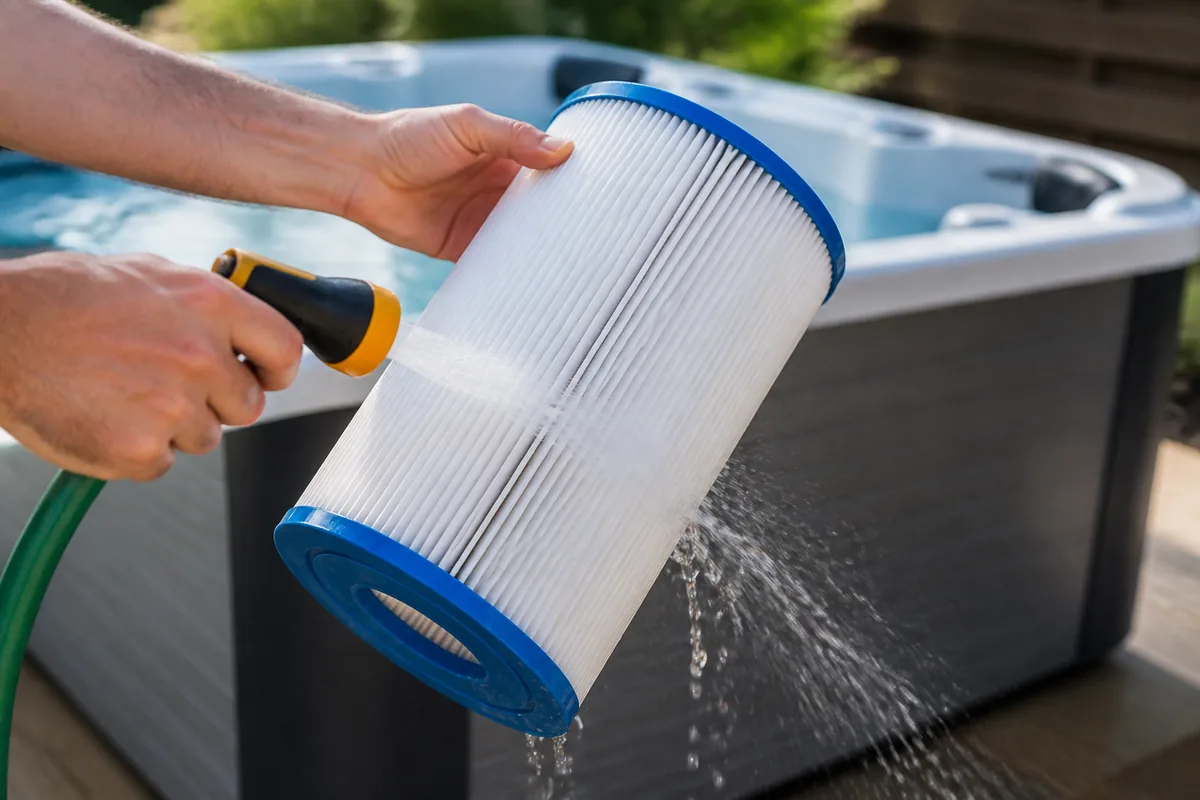
Jacuzzi’s cleaning guide describes removing the filter and rinsing it with a garden hose at moderate pressure, directing water between each pleat from top to bottom and rotating the cartridge for even coverage, then letting it air dry before reinstalling (Jacuzzi). Jacuzzi’s separate filter-care guide adds that the filter does not need to dry completely before going back in for routine weekly maintenance, and recommends inspecting for tears or cracked end caps while you rinse (Jacuzzi). Sundance’s guide describes the same rinse-between-the-pleats approach and notes that it’s safe to reinstall the cartridge while still damp (Sundance Spas). Both manufacturers warn against high-pressure nozzles or pressure washers, which can tear filter fibers.
The deep clean or soak
Beyond the weekly rinse, both brands describe soaking the filter in a dedicated cleaning solution. Jacuzzi’s method: pre-rinse the filter, mix a commercial filter cleaner with warm water in a bucket large enough to submerge the cartridge, and soak for roughly 8 to 24 hours depending on which Jacuzzi guide you follow, then rinse thoroughly until no cleaner scent or foam remains (Jacuzzi; Jacuzzi). Sundance describes a similar overnight soak of 8 to 12 hours, followed by a thorough rinse until no suds remain (Sundance Spas). For hard water, Jacuzzi’s guide mentions white vinegar can help dissolve mineral deposits during a soak, while Sundance’s guide describes a similar occasional use of vinegar for light scale, though both note it’s milder than a dedicated filter cleaner for heavy buildup (Jacuzzi; Sundance Spas).
What manufacturers say not to use
Both Jacuzzi and Sundance list the same products to avoid: bleach and other chlorine-based household cleaners, dish soap and laundry detergent, dishwashers, pressure washers, and wire or stiff brushes, all of which can damage filter media or cause persistent foaming in the water (Jacuzzi; Sundance Spas). Sundance also specifically warns against mixing different cleaning chemicals, such as an acid and chlorine, in the same bucket (Sundance Spas). Follow the dosing instructions on your own filter cleaner’s label rather than guessing at a concentration.
Jacuzzi’s cleaning guide explains the reasoning behind some of these warnings: household cleaners “are formulated for hard surfaces, not delicate filter media,” residue left behind “can cause foaming” in spa water, and a dishwasher’s high heat “can melt filter end caps” while its fixed spray pattern misses the space between pleats (Jacuzzi). If a filter cleaner’s label recommends a specific dilution or soak time, following that label takes priority over any general figure mentioned here.
Drying, reinstalling, and restarting
Jacuzzi’s cleaning guide notes that filters can be reinstalled damp after a routine weekly rinse, but recommends letting a filter dry completely after a deep soak if you’re not swapping in a second cartridge, since trapped moisture in the pleats can promote mold growth (Jacuzzi). Sundance describes the same allowance for reinstalling a damp filter after a rinse, noting that its systems are designed to operate with a wet cartridge (Sundance Spas). Both manufacturers recommend running the jets briefly after reinstalling the filter to confirm normal water flow and to check that no error codes appear on the control panel before considering the job done.
If this routine seems to need repeating far more often than the schedule in How Often Should You Clean a Hot Tub Filter? suggests, see Why Does My Hot Tub Filter Get Dirty So Fast? for the documented reasons a filter can clog faster than expected.
Safe checks the homeowner can do
- Turn off power before removing the filter, following your owner’s manual.
- Rinse between every pleat with a garden hose, using moderate pressure rather than a pressure washer.
- Inspect the filter as you rinse for tears, cracked end caps, or pleats that no longer spring back.
- Soak in a dedicated spa filter cleaner on the schedule your manual or How Often Should You Clean a Hot Tub Filter? suggests, following the product label’s dosing.
- Rinse thoroughly after soaking until no cleaner scent, foam, or suds remain before reinstalling.
- Restore power and run the jets briefly to confirm normal flow and check for error codes.
When to stop and call a technician
- The filter shows damage (tears, cracked end caps, collapsed pleats) rather than just dirt. See When Should You Replace a Hot Tub Filter?. When you are ready to buy a cartridge, use How to Choose a Replacement Hot Tub Filter for part-number and fit checks.
- Cleaning doesn’t restore water flow, and jets stay weak or the spa stops heating. See Can a Dirty Filter Stop a Hot Tub From Heating?
- The spa shows a flow-related error code again immediately after a clean filter is reinstalled (see Jacuzzi FL1, Sundance FL1, or Gecko FLO if that’s the exact message)
- You notice foaming that doesn’t clear after a thorough rinse, which can indicate leftover cleaning solution or a chemistry issue beyond the filter
These are signs the issue may be beyond what cleaning alone can fix, and a qualified technician or your spa dealer is the appropriate next step. Settled sand or silt on the shell floor is a separate cleanup task from filter care; see How to Choose a Hot Tub Vacuum if you need a tool for that debris.
Sources
- How to Clean Hot Tub Filter — Jacuzzi; Accessed 2026-07-30
Official Jacuzzi guide with step-by-step rinse and deep-soak instructions, and a list of products to avoid.
- Hot Tub Filter Cleaning Made Easy — Jacuzzi; Accessed 2026-07-30
Separate official Jacuzzi guide with a step-by-step weekly rinse and monthly deep-clean routine, including power-off instructions.
- How to Clean a Hot Tub Filter (Using Sundance Spa Filters the Right Way) — Sundance Spas; Accessed 2026-07-30
Official Sundance Spas guide with weekly rinse and monthly deep-clean steps, plus a table of cleaning methods and products to avoid.
Related articles
How Often Should You Clean a Hot Tub Filter?
Hot tub filter cleaning schedules vary by manufacturer, and even by document. Here's what Jacuzzi, Sundance, and Hot Spring publish, and how to set yours.
Read guideWhen Should You Replace a Hot Tub Filter?
Replace a hot tub filter when it's damaged, or when cleaning stops restoring water clarity and flow. Documented age-based intervals vary widely by brand.
Read guideWhy Does My Hot Tub Filter Get Dirty So Fast?
Manufacturers point to body oils and lotions, heavy bather load, and hard water as documented reasons a hot tub filter can clog faster than a baseline schedule.
Read guideCan a Dirty Filter Stop a Hot Tub From Heating?
Yes. A clogged filter can trip a hot tub's safety switches and stop the heater. Here's how to check and clean it safely.
Read guide