Buying Guideswater-testing
What to Look for in a Hot Tub Water Test Kit
Choose a test kit that matches the sanitizer system you actually use and the parameters your spa manual expects you to track. For chlorine and pH, CDC home pool and hot tub guidance says a DPD test kit gives more accurate results than test strips.
- By
- TubWise Editorial Team
- Published
- Last updated
- hot tub test kit
- water testing
- test strips
- buying guide
Direct answer
Pick a kit that can measure the sanitizer you actually use, plus pH and the other balance parameters your spa manual lists. For chlorine and pH in home pools and hot tubs, CDC says a DPD test kit gives more accurate results than test strips (CDC). That is CDC testing guidance, not a product endorsement. Always follow the directions that come with the kit.
Chemical safety
Test kits help you monitor chemistry. They do not dose chemicals for you. Follow the sanitizer and balancer product labels, your spa’s listed volume, and your owner’s manual. Do not mix chlorine and bromine systems. See Chlorine vs Bromine for Hot Tubs: How to Choose.
How TubWise researched this guide
This guide is desk research based on CDC Healthy Swimming guidance, spa manufacturer water-care pages, and kit instructions those sources point owners toward. TubWise did not independently lab-test test kits or digital readers. The focus is selection criteria, not naming a universal winner. Kit formulas, packaging, and availability can change, so confirm current product details before purchasing.
Decide what you need to measure
Not every kit measures every parameter. Start with your owner’s manual, then buy a kit that covers what that manual expects. Common parameters in Jacuzzi guidance include:
- sanitizer (chlorine or bromine, matching the system in the spa)
- pH
- total alkalinity
- calcium hardness when the manual or water-care plan calls for it
Jacuzzi’s beginner setup guide describes using test strips or a digital meter, testing the fill water, then tracking sanitizer and balance during startup and ongoing care (Jacuzzi). Its swim-spa maintenance guide lists pH, total alkalinity, free chlorine or bromine, and calcium hardness among the parameters to monitor in that product context (Jacuzzi). Use your own manual’s list if it differs.
If you have not chosen a sanitizer system yet, settle that before buying a kit that only works for one chemistry.
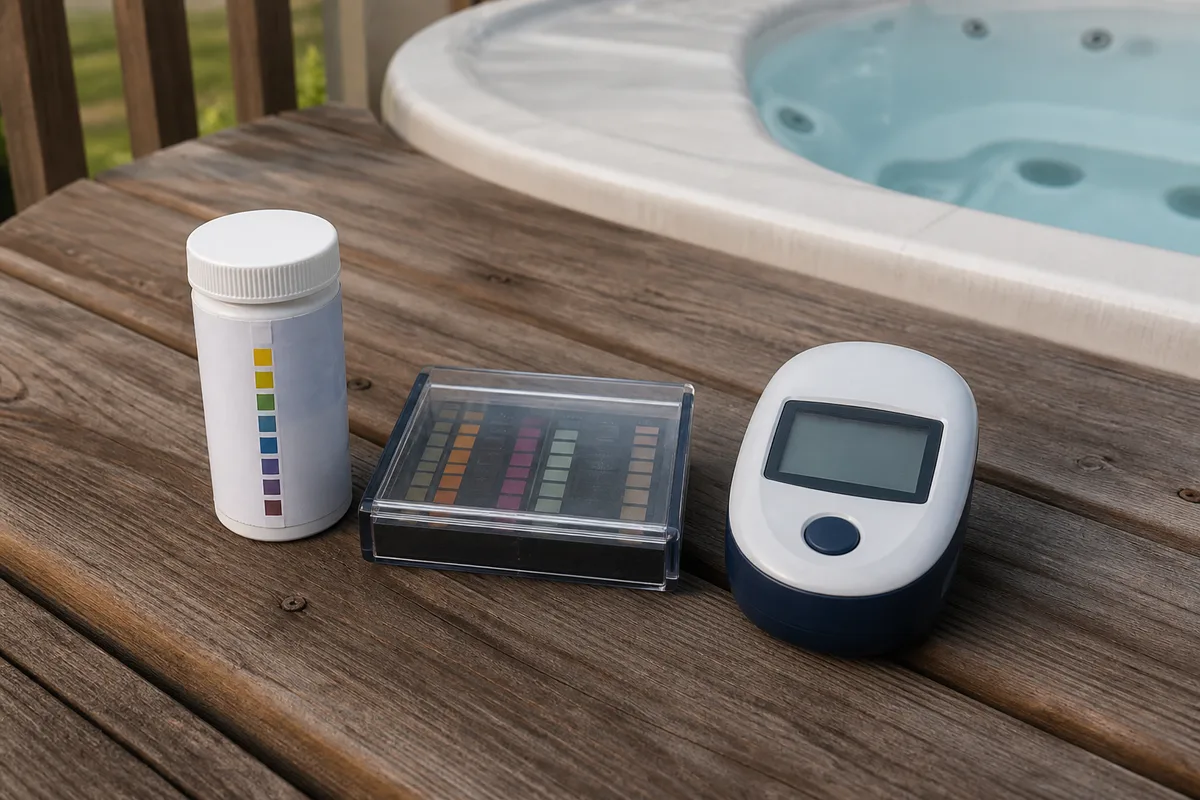
Strips, liquid kits, and digital readers
Test strips
Strips are fast and common. Dip, wait the labeled time, and compare colors to the bottle chart. CDC says owners can use strips, but they are less accurate than a DPD test kit for chlorine and pH (CDC). Follow the strip bottle’s timing and comparison instructions carefully; color charts leave room for reader error.
Liquid DPD reagent kits
For the most accurate chlorine and pH results in home pools and hot tubs, CDC recommends a DPD test kit (CDC). DPD is a reagent method (N,N-diethyl-1,4-phenylenediamine sulfate). Some kits use color comparison; others use drop-count titration. Follow the kit booklet exactly. This CDC comparison applies to chlorine and pH testing methods, not to every parameter a spa kit might include.
CDC also warns that when chlorine is above about 10 ppm, a DPD test can bleach out and show a false low or zero reading (CDC). Retest as the kit instructions describe.
Digital readers
Jacuzzi mentions digital testing meters alongside strips as a testing option (Jacuzzi). Digital tools still depend on fresh reagents or strips made for that device, any calibration the maker requires, and the manufacturer’s directions. A digital display does not by itself prove the water is safe to enter.
Match the kit to the sanitizer
Jacuzzi UK states that chlorine and bromine must not be combined and that owners must choose one system or the other (Jacuzzi UK). Buy a kit that clearly supports the sanitizer you use. A chlorine-only kit is the wrong tool for a bromine spa, and the reverse is also true unless the product labeling says both are supported with the correct procedure.
If your spa uses a manufacturer-specific cartridge or mineral system, check whether that system requires its own test method or target range in the spa manual.
Storage, expiration, and replacement reagents
Before you buy, check the package and instructions for:
- an expiration or use-by date on strips or reagents
- storage directions from the kit maker
- whether replacement reagents or strip bottles are sold separately
- whether the instructions are readable and complete
Follow those labeled directions. Do not rely on an expired kit or one stored outside the maker’s instructions.
What a test result does not prove
A single reading does not prove the water is safe for every person or situation. CDC ties germ control to maintaining free chlorine concentration and pH together, and notes that some germs remain chlorine-tolerant even in well-maintained water (CDC). Jacuzzi swim-spa guidance tells owners to wait for label wait times and confirm safe sanitizer levels before use (Jacuzzi). For how often to test, including CDC twice-daily chlorine and pH checks versus brand weekly schedules, see How Often Should You Test Hot Tub Water?.
Do not use this page for dosing amounts. Prefer the spa manufacturer’s listed capacity when a product label needs gallons or liters. The Hot Tub Volume Calculator is only an estimate aid when the listed capacity is unknown.
Safe checks when choosing a kit
- Confirm whether the spa uses chlorine, bromine, or another documented system.
- List the parameters your owner’s manual expects you to track.
- Decide whether you need strip convenience, liquid DPD precision, or a digital reader that uses fresh consumables.
- Check expiration, storage needs, and replacement reagent availability.
- Read the directions before the first use and keep them with the kit.
- Retest after any large chemistry change on the schedule your manual or label describes.
When to stop and get help
Contact your dealer or a water-care professional if:
- results conflict across two methods and you cannot resolve the difference with fresh reagents
- the kit instructions do not match your sanitizer system
- cloudy, green, or foamy water continues after testing and labeled corrections
For symptom context, see Why Is My Hot Tub Water Cloudy?, Hot Tub Water Cloudy After Adding Chemicals, Why Is My Hot Tub Water Foamy?, and Why Is My Hot Tub Water Green?.
Sources
- Home Pool and Hot Tub Water Treatment and Testing — Centers for Disease Control and Prevention; Accessed 2026-08-01
CDC Healthy Swimming page, updated May 10, 2024. For most accurate testing results, recommends a DPD test kit for chlorine and pH; states test strips can also be used but are less accurate; always follow manufacturer directions. Includes CDC hot-tub chlorine and pH recommendations and cyanuric-acid caution for hot tubs. Scope is residential pool and hot tub water treatment generally, not a specific spa brand.
- Complete Beginner's Guide to Setting Up Your Jacuzzi — Jacuzzi; Accessed 2026-08-01
Official Jacuzzi guide. Mentions quality test strips or a digital testing meter; twice-weekly ongoing testing; tracking sanitizer, pH, alkalinity, and calcium hardness on different schedules; enter only when chemistry is properly balanced. Used for manufacturer testing-practice context, not as universal dosing advice.
- The Complete Guide to Swim Spa Maintenance — Jacuzzi; Accessed 2026-08-01
Official Jacuzzi swim-spa maintenance guide. Lists target ranges for pH, alkalinity, free chlorine, bromine, and calcium hardness for that product context; instructs owners not to use the swim spa until label wait times pass and test strips confirm safe sanitizer levels. Used for parameter lists and label-deference language; do not treat ranges as universal for every hot tub.
- Chlorine vs bromine – What’s best for my hot tub? — Jacuzzi UK; Accessed 2026-08-01
Official Jacuzzi UK learning article. States owners must choose chlorine or bromine and never combine them. Used to support buying a kit that matches the chosen sanitizer system.
Related articles
How Often Should You Test Hot Tub Water?
CDC guidance says test hot tub chlorine and pH at least twice a day. Manufacturer maintenance schedules may list weekly or twice-weekly checks. Here's how to use both.
Read guideChlorine vs Bromine for Hot Tubs: How to Choose
Compare chlorine and bromine as hot tub sanitizer systems using manufacturer guidance. Choose one system and follow the label.
Read guideWhy Is My Hot Tub Water Cloudy?
Cloudy hot tub water can trace back to water chemistry, sanitizer, filtration, or old water. Here's how to narrow it down and when to stop using the spa.
Read guideHot Tub Water Cloudy After Adding Chemicals
If your hot tub turned cloudy right after adding chemicals, the cause can be the order, amount, or mix of products used. Here's what to check.
Read guideWhy Is My Hot Tub Water Foamy?
Foamy hot tub water can trace back to soap and body products, low calcium hardness, or old water. Here are the causes manufacturers document and what to check.
Read guideWhy Is My Hot Tub Water Green?
Green hot tub water can point to algae from low sanitizer and high pH, or dissolved iron and copper. Here's how manufacturers describe telling them apart.
Read guide